How to Polish Wine Glasses to a Streak-Free Shine
Quick Answer: Polish a wine glass after washing and rinsing it. Hold the bowl with one clean cloth under it, polish the inside and outside with a second cloth, then polish the base. Never twist the bowl against the stem. Polishing finishes a clean glass. It cannot remove film or etching, and no maker cited here includes a steam step.
Polishing is the last step of the routine in how to clean wine glasses. This post covers the technique in more detail, what to do when a glass still streaks, and how to dry without a microfiber cloth. For why streaks form in the first place, see The Secret to Streak-Free Crystal.
How do you polish a wine glass?
With two clean, lint-free cloths and a washed glass, in this order:
- Rinse the glass thoroughly so no detergent is left.
- Hold the glass with a cloth under the bowl, or rest the bowl in one hand.
- With the second cloth, polish the inside and the outside of the bowl gently.
- Hold the base firmly with one hand and polish it with the other.
Waterford says not to twist the bowl in the opposite direction to the stem when washing and drying, because that can cause damage. It also says the finely made rims are the most fragile part, so go gently there, and Rückl says the same of the thin upper rim. Stop using a glass that is chipped or cracked.
Why is my glass still streaky after polishing?
Usually because the problem was not on the surface a cloth can fix.
| What you see | Likely cause | What to do |
|---|---|---|
| Lint or fibers | A cloth that sheds | Use a clean lint-free cloth. Waterford asks for lint-free, and Libbey asks for no fibers left behind |
| Chalky spots or haze that returns | Hard-water film | Libbey and Val Saint Lambert name white vinegar to remove limescale. Rinse well |
| Cloudy layer after washing | Detergent residue | Rinse thoroughly. Whirlpool says the wrong amount or type of detergent can leave a film |
| Dull patches that stay after vinegar | Etching | Permanent, per Libbey. See how to clean cloudy drinking glasses |
Can you dry wine glasses without a microfiber cloth?
Yes. No maker cited names microfiber. Waterford asks for a lint-free cloth, Libbey for a lint-free towel that leaves no fibers behind, Val Saint Lambert for a soft, non-fluffy cloth, and Rückl for a clean cloth. So the shared rule is no lint, whatever the fabric. You can also air-dry if the last rinse is mineral-free: the Corning Museum of Glass conservators suggest rinsing with distilled or deionized water, after which air drying or towel drying are both fine. If you air-dry glasses, Waterford says not to stand them upside down on their rims. The US Geological Survey says hard water is one of the most common causes of cloudy glassware, and that is what air-drying in ordinary tap water can leave behind. The differences between cloths are in the guide to microfiber glass cloths.
Do you need steam or a warm glass to polish?
No maker cited here says so. Waterford, Libbey, Val Saint Lambert, Rückl and the Corning Museum of Glass describe a wash, a rinse and a dry cloth, with no steam step. Waterford warns that extreme temperatures can crack glass, and Rückl warns that sudden temperature changes can raise the internal stress in deeply cut crystal. This post leaves steam out. The same goes for polishing a glass while it is still warm from the wash: no maker cited requires it.
Where does the Excalibur Brothers cloth fit?
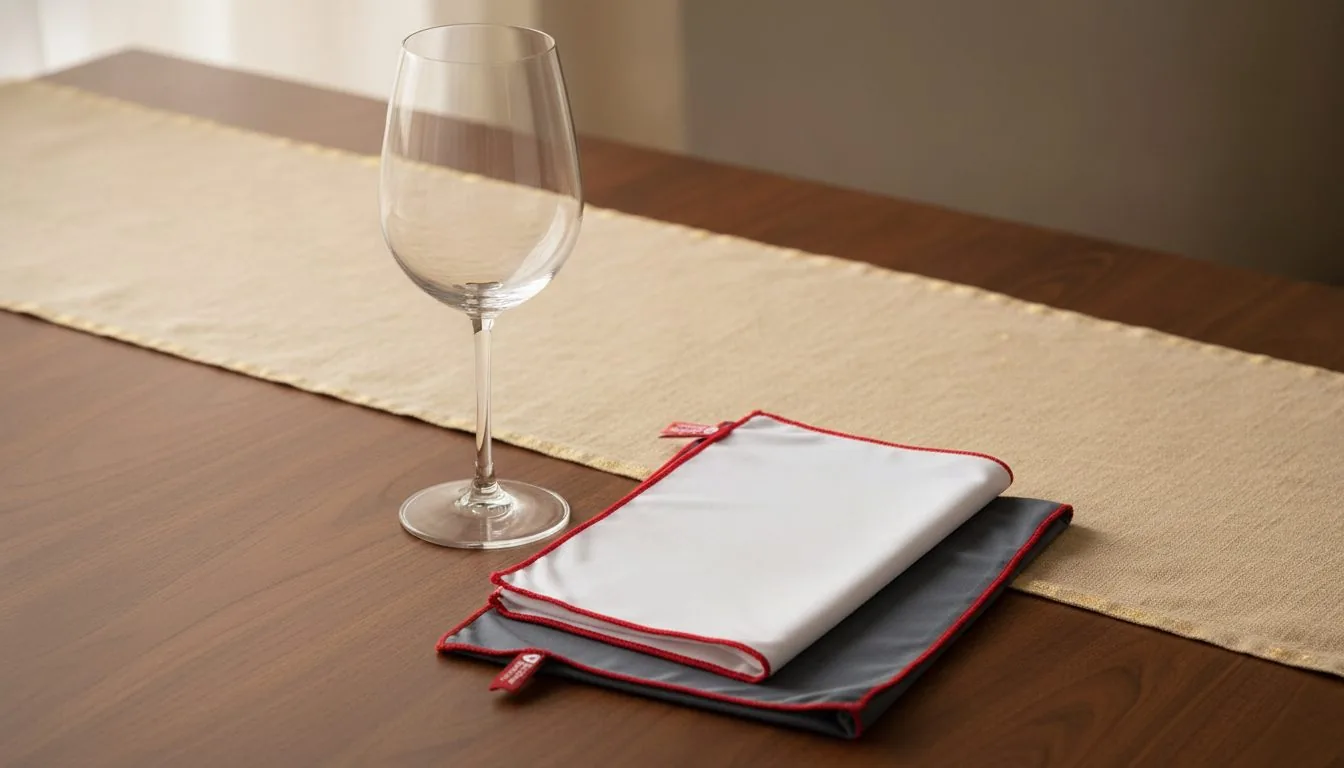
The Excalibur Brothers Premium Glass Polishing Cloth is our own product, sold on this site. It is a large microfiber cloth, listed at 23.5 x 20 inches per cloth, and the pack of two matches a two-cloth method. The Premium Glass Polishing Cloth in an assorted pair sits in the collection beside white and gray. The product page says to use it dry or barely dampened.
When this is not the right choice: if you already have two clean, large, lint-free cloths, you do not need another pair. A cloth also cannot polish out film or etching.
Frequently asked questions
How do you polish crystal glasses?
The same way, gently. Val Saint Lambert says to dry crystal carefully with a soft, non-fluffy cloth. The US EPA says to avoid storing or serving food and liquids in lead crystal, and more so if it is chipped or cracked. Only the maker can say whether a piece contains lead.
How do you polish wine glasses fast?
Rinse well so there is nothing to polish off, use a large clean cloth in each hand, and do not stop to fight film. If a glass is hazy, it needs vinegar, not more polishing.
Should you polish wine glasses while they are still warm?
None of the maker pages cited says to. Waterford says to wash in warm soapy water and rinse thoroughly, then dry with a lint-free cloth.
How do you keep a polishing cloth from leaving streaks?
Keep it clean and lint-free, and wash it as its care label says. A cloth that sheds fibers leaves lint, which fails the rule Waterford and Libbey both give.
Can you polish out etching?
No. Libbey says there is no practical method to restore etched glass, and Corning Museum of Glass conservators say cloudiness that is surface deterioration cannot be fixed.
Is it safe to polish a thin stem?
Yes, if you support the bowl and never twist it against the stem. Waterford says twisting the bowl in the opposite direction to the stem can cause damage.